
What Happened in 41 BCE Was All Down to Scent
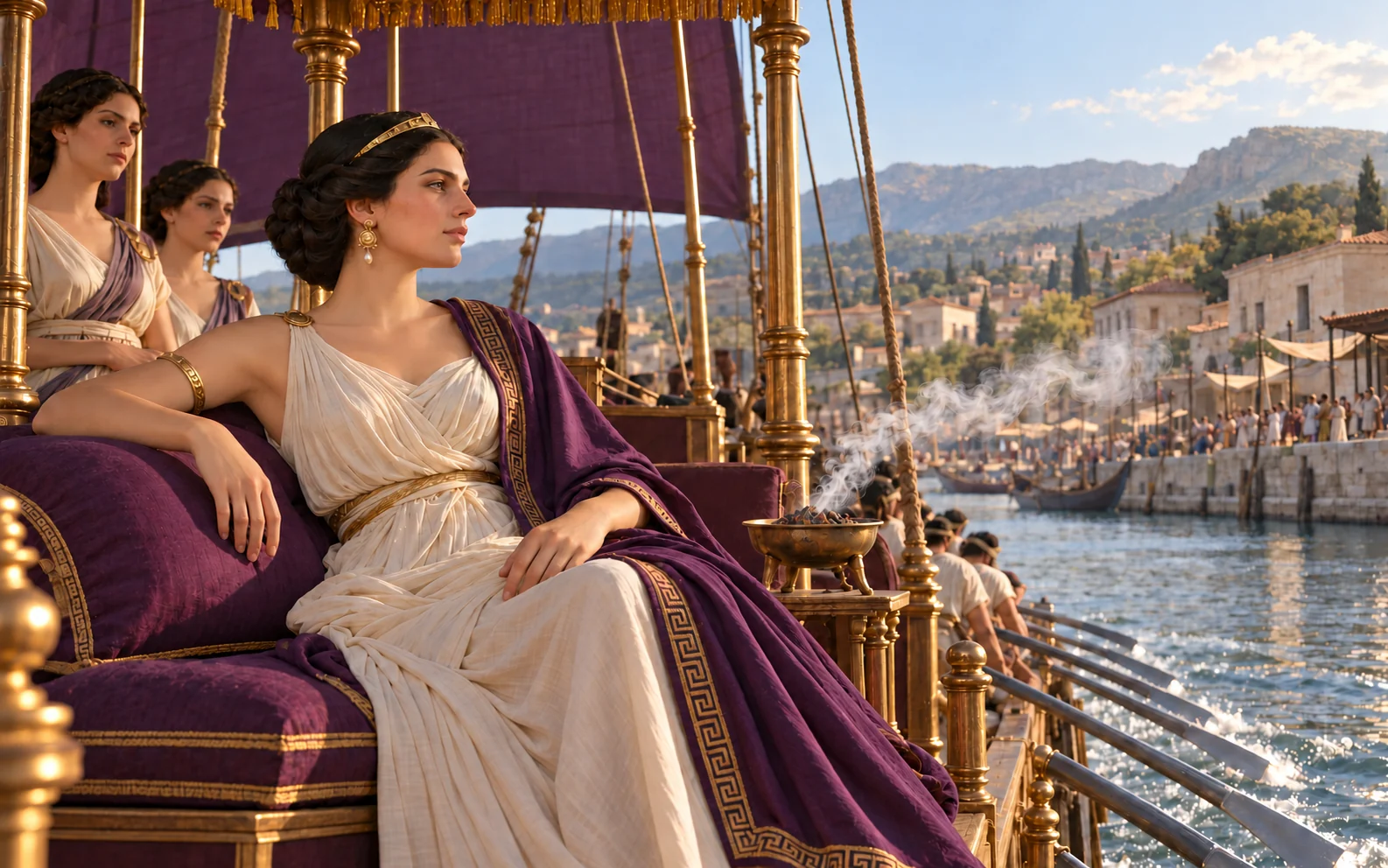
Artistic reconstruction of Cleopatra’s arrival at Tarsus in 41 BCE.
Mark Antony summoned a queen. Cleopatra gave him an entrance history never quite forgot.
In 41 BCE, she sailed to Tarsus, in present-day southern Turkey, for a meeting charged with political consequence. She arrived with purple sails, music and incense drifting towards the riverbanks. The story of how Cleopatra used perfume begins here, with fragrance becoming part of the spectacle around her.
How Cleopatra Used Perfume to Make an Entrance
The famous account comes from Plutarch, writing more than a century later. He describes a barge with a gilded stern and silver oars moving to the sound of flutes, pipes and lutes. Cleopatra reclined beneath a gold-adorned canopy, presented in the likeness of Aphrodite, the goddess the Romans knew as Venus.
Incense spread fragrance along the banks of the River Cydnus. Crowds followed the vessel; others left the city to watch. In the telling, Antony was left sitting alone in the marketplace.
He had asked Cleopatra to come to him. The city’s attention had already gone to her.
Gold could be admired from a distance. Fragrance entered the air around the onlookers. Alongside the music and magnificent vessel, it helped give the arrival an atmosphere that extended beyond the queen herself.
That is the detail worth lingering over. Scent formed part of an entire occasion, giving Cleopatra’s presence an aromatic reach beyond the deck on which she reclined.
The Scent Behind the Legend
The sails are often said to have been soaked in perfume. The ancient account describes incense and purple sails separately; the explicitly perfumed sails appear in Shakespeare’s later Antony and Cleopatra. The image is beautiful, but it belongs to the literary retelling.
What the incense actually smelled like remains unknown. Its ingredients are not named, and the description supplies no formula for Cleopatra’s personal perfume either. A specific blend of myrrh, frankincense or other aromatics would be a guess, however convincing it might sound.
We are left with the occasion rather than the recipe: fragrance on the river, a queen beneath a gilded canopy, and a crowd drawn towards her arrival.
What Lingered
Antony later invited Cleopatra to dine. She proposed that he come to her instead, and he accepted. The woman he had summoned became his hostess.
Perfume alone cannot explain their attraction or the alliance that followed. Her conversation, intelligence and presence mattered, as did their political interests. Yet fragrance remains one of the most evocative details of that encounter.
For anyone who loves perfume, the appeal is familiar: a scent becoming inseparable from the impression of a person. We cannot recover what those riverbanks smelled like, but we can still understand why the detail endured.
The incense dispersed long ago. The entrance never quite did.